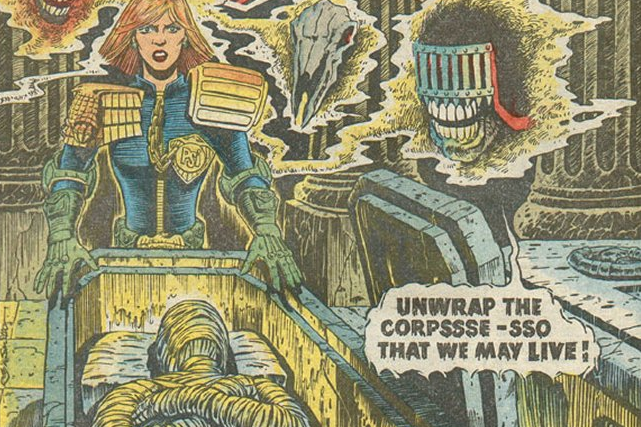
This two-parter marks the first real move towards treating Judge Death as a figure of fun, and I guess your perspective on this story largely depends on whether you prefer they were kept as dark figures of evil. As someone fairly new to the world of Dredd, I'm not very bothered by it. With nearly 40 years of history as characters, they couldn't just stay the same evil doom-merchants.
Ian Gibson takes the cartoony elements of the story pretty literally, and the whole thing almost reads like some sort of cartoon version of Dredd Vs. Death. The two of them time-travelling back to 1994 to muck around with some senior citizens is a far cry from what we've seen before, and presented alongside the other stories in this Volume it certainly stands out.
My main issue with this story is largely just confusion - who is Death addressing as he narrates the story? Why exactly does he think this story will raise support for him, and undermine Dredd? Death tries to claim the story is about how similar he and Dredd are, but that doesn't really come across.
This is the first big step in moving Death into comic territory before bringing him back. I guess we'll see how the rest of those stories play out in this Collection.
Showing posts with label 2000 AD. Show all posts
Sunday, 1 July 2018
Saturday, 30 June 2018
37: Theatre of Death
A fairly straightforward two-parter taking place immediately after Necropolis, Theatre of Death touches on few things that deal with the aftermath of that epic. Dredd is still not winning any beauty contests, and indeed is still being mistaken for Judge Death himself. The Judges are back on the beat, with the hunt for Judge Death a priority. We get some closure on Chief Judge Silver, who obtains some measure of redemption as a recording shows that he held out against the power of the Dark Judges until the end.
It's unfair of course to compare this story to the run of fan-favourite ones we've had recently, but this just feels a bit flat. Holograms and displays are often a bit tricky to show in art, so I had a bit of difficulty working out what was going on in some cases.
Overall this story mainly serves to show that even the idea of the Dark Judges is enough to cause chaos and confusion, and that the corruption of the Judges in Necropolis will have an impact on Justice Department and Mega-City One for a long time.
It's unfair of course to compare this story to the run of fan-favourite ones we've had recently, but this just feels a bit flat. Holograms and displays are often a bit tricky to show in art, so I had a bit of difficulty working out what was going on in some cases.
Overall this story mainly serves to show that even the idea of the Dark Judges is enough to cause chaos and confusion, and that the corruption of the Judges in Necropolis will have an impact on Justice Department and Mega-City One for a long time.
36: Four Dark Judges
Anderson was a natural pick for her own series, and Four Dark Judges works well both as a continuation of the Dark Judges story and as Anderson's first solo adventure. Over 12 parts this gets a lot more room to breathe than Judge Death Lives, and is all the better for it. Anderson is a great lead, with fairly equal mixtures of lightness and darkness as she is tricked by the Dark Judges into resurrecting them.
The other standout star here is Brett Ewins. Following Brian Bolland must be one of the trickiest jobs out there, but I was taken in by Ewins' work throughout the whole story. He does a great job of continuing Bolland's style while making it his own.
This is another highlight of the Mega Collection for me. I've got a real soft spot for these epic, plot-heavy and cliffhangery (a technical term!) adventures from the early days of 2000AD. Anderson's got a lot ahead of her after this story, but coming back to her official beginning is always fun.
The other standout star here is Brett Ewins. Following Brian Bolland must be one of the trickiest jobs out there, but I was taken in by Ewins' work throughout the whole story. He does a great job of continuing Bolland's style while making it his own.
This is another highlight of the Mega Collection for me. I've got a real soft spot for these epic, plot-heavy and cliffhangery (a technical term!) adventures from the early days of 2000AD. Anderson's got a lot ahead of her after this story, but coming back to her official beginning is always fun.
Friday, 15 June 2018
35: Judge Death Lives
Brian Bolland's artwork was so iconic in Judge Death that he was faced with a seemingly impossible task here. Not only did he have to try and beat his previous work, he also had to introduce three of Death's "cousins". Bolland somehow not only tops his artwork for the previous story, he also builds on Death's instantly iconic design by doing it again three times! Fear, Fire and Mortis are each distinctive, over-the-top and brilliant.
It isn't just in the Dark Judges that Bolland excels. His taken on Anderson is still one of my favourites, and he does some magnificent "hero-shots" with her - the full-page of Anderson and Dredd bursting through the Dark Judges' shield is a particular favourite of mine.
In fact, this story surprised me in how much it sidelines Dredd and makes this about a rematch not between Dredd and Death, but between Anderson and Death. There's a great confidence there in allowing Dredd to take a back seat, and really highlighting how Anderson was too great a character to be left encased in Boing. The Dark Judges very much see Anderson as the enemy they have to face, and Anderson does all the heavy lifting in breaking through the shield and then finally defeating the superfriends on their home soil.
Speaking of Deadworld, the only major problem with this story is how it's structured. It really needed to be more than five parts, or for the action to be redistributed. The Dark Judges taking down the citizens of a single Block is great, but it means that the action on Deadworld is limited to basically three pages. Bolland does incredible work here, but it's over way too quickly. I know we'll be seeing a lot more of Deadworld before too long, but it's such an evocative landscape and story that it really either needed to have more time here, or for it to not appear at all.
It isn't just in the Dark Judges that Bolland excels. His taken on Anderson is still one of my favourites, and he does some magnificent "hero-shots" with her - the full-page of Anderson and Dredd bursting through the Dark Judges' shield is a particular favourite of mine.
In fact, this story surprised me in how much it sidelines Dredd and makes this about a rematch not between Dredd and Death, but between Anderson and Death. There's a great confidence there in allowing Dredd to take a back seat, and really highlighting how Anderson was too great a character to be left encased in Boing. The Dark Judges very much see Anderson as the enemy they have to face, and Anderson does all the heavy lifting in breaking through the shield and then finally defeating the superfriends on their home soil.
Speaking of Deadworld, the only major problem with this story is how it's structured. It really needed to be more than five parts, or for the action to be redistributed. The Dark Judges taking down the citizens of a single Block is great, but it means that the action on Deadworld is limited to basically three pages. Bolland does incredible work here, but it's over way too quickly. I know we'll be seeing a lot more of Deadworld before too long, but it's such an evocative landscape and story that it really either needed to have more time here, or for it to not appear at all.
Thursday, 14 June 2018
34: Judge Death
A small three-parter that would have huge ramifications, and another story that's already been analysed to Death (pardon the pun). Indeed, it is the most reprinted Judge Dredd story of all time.
Baddies are always more fun, so it’s no surprise that Judge Death gets the starring role here, but for me Anderson is the real standout character. Death is very well-realised by Bolland and his bizarre inversion of the Judges is a great conceit, but Anderson in two episodes (she doesn't even appear in the first episode!) manages to make a mark as a character and then demonstrate strength and resilience in dealing with the problem. The use of Boing, a comedy product from a fun episode, to resolve a dark and dramatic evil is also cleverly done.
A packed three episodes that will have huge ramifications – and they all work excellently. Judge Death and his superfiend cousins will take some epic twists and turns from this point on, but you can make a very solid argument that it's hard to top this initial story.
Baddies are always more fun, so it’s no surprise that Judge Death gets the starring role here, but for me Anderson is the real standout character. Death is very well-realised by Bolland and his bizarre inversion of the Judges is a great conceit, but Anderson in two episodes (she doesn't even appear in the first episode!) manages to make a mark as a character and then demonstrate strength and resilience in dealing with the problem. The use of Boing, a comedy product from a fun episode, to resolve a dark and dramatic evil is also cleverly done.
A packed three episodes that will have huge ramifications – and they all work excellently. Judge Death and his superfiend cousins will take some epic twists and turns from this point on, but you can make a very solid argument that it's hard to top this initial story.
Monday, 11 June 2018
33: Necropolis
There are maybe 5-10 Dredd stories that were so big when first published, and have been analysed and examined so often since, that it can be challenging to find much to say about them that hasn't already been said - and said better. America was one, and Necropolis is most certainly another.
I'm not going to have some contrarian view or any sort of "hot take" here: Necropolis is great. John Wagner's work feels energised and urgent, driven by the themes that have been bubbling away all this through this and the previous Volume: duty, becoming obsolete, inheritance and how succession works (or doesn't) to name just a few. Even though Necropolis has 26 episodes to play with, Wagner wastes no time in getting to work. Dredd's apartment is destroyed in fire right at the start - the very last symbolic act of his removal from Mega-City One.
I was surprised just how quickly Kraken falls to the power of the Sisters. My memory of my first read of this story was that it was a much longer struggle - but it's insanely quick. I'm always impressed with how Wagner doesn't go for the obvious. We could have had 10 episodes of inner turmoil and struggle, but Wagner doesn't see any point in hiding the inevitable conclusion: Kraken is weak, and always was.
In the end, amidst all the fantastic scenes of the City under the power of the Sisters and the Dark Judges, this run of stories has always been about Dredd - how reliant the City is in him, how fallible he is and how hard he will be to replace when the time comes. Kraken should have been the ultimate replacement - honed to be a Judge. But he falls at the very first hurdle. And when he falls, the entire system falls. The Judges end up under the power of the Sisters, oppressing the citizens they are meant to protect.
Mega-City One is imperilled by "The Perfect Judge", working as a solo force. It is saved by a group of the imperfect - raw cadets not yet Judges; somewhat crazy McGruder; injured Anderson; and Dredd himself. Kraken was used by Odell and Silver after they thought Dredd was past it - but the City is eventually saved with the return of two "old-timers", Dredd and McGruder, from out of the Cursed Earth. In the end the idea of a single superhuman Judge can't work. It's working together with others that fight on despite what holds them back that allows Dredd to do what he does.
In the end Kraken is a tragic and doomed figure. Used by the Judda, then by the Justice Department, then by the Sisters. Kraken was meant to the perfect solo Judge, a man alone enforcing the Law - and it turned out that the one thing he could never be was his own man. Dredd eventually gives Kraken the only release he can - some measure of acknowledgement that Kraken was a victim, and then a quick death.
Everything around this central issue is just window dressing, but the majority of it is very entertaining. Carlos Ezquerra's colour-stained artwork is evocative and gripping; the return of McGruder is hilarious and her unlikely buddy comedy road trip with Dredd is a fun mid-story diversion.
At the time, Necropolis was the finale to a masterclass in storytelling by John Wagner, bringing together story threads from years previously to this renewal of Dredd. It's still effective today. What else is there really to say?
I'm not going to have some contrarian view or any sort of "hot take" here: Necropolis is great. John Wagner's work feels energised and urgent, driven by the themes that have been bubbling away all this through this and the previous Volume: duty, becoming obsolete, inheritance and how succession works (or doesn't) to name just a few. Even though Necropolis has 26 episodes to play with, Wagner wastes no time in getting to work. Dredd's apartment is destroyed in fire right at the start - the very last symbolic act of his removal from Mega-City One.
I was surprised just how quickly Kraken falls to the power of the Sisters. My memory of my first read of this story was that it was a much longer struggle - but it's insanely quick. I'm always impressed with how Wagner doesn't go for the obvious. We could have had 10 episodes of inner turmoil and struggle, but Wagner doesn't see any point in hiding the inevitable conclusion: Kraken is weak, and always was.
In the end, amidst all the fantastic scenes of the City under the power of the Sisters and the Dark Judges, this run of stories has always been about Dredd - how reliant the City is in him, how fallible he is and how hard he will be to replace when the time comes. Kraken should have been the ultimate replacement - honed to be a Judge. But he falls at the very first hurdle. And when he falls, the entire system falls. The Judges end up under the power of the Sisters, oppressing the citizens they are meant to protect.
Mega-City One is imperilled by "The Perfect Judge", working as a solo force. It is saved by a group of the imperfect - raw cadets not yet Judges; somewhat crazy McGruder; injured Anderson; and Dredd himself. Kraken was used by Odell and Silver after they thought Dredd was past it - but the City is eventually saved with the return of two "old-timers", Dredd and McGruder, from out of the Cursed Earth. In the end the idea of a single superhuman Judge can't work. It's working together with others that fight on despite what holds them back that allows Dredd to do what he does.
In the end Kraken is a tragic and doomed figure. Used by the Judda, then by the Justice Department, then by the Sisters. Kraken was meant to the perfect solo Judge, a man alone enforcing the Law - and it turned out that the one thing he could never be was his own man. Dredd eventually gives Kraken the only release he can - some measure of acknowledgement that Kraken was a victim, and then a quick death.
Everything around this central issue is just window dressing, but the majority of it is very entertaining. Carlos Ezquerra's colour-stained artwork is evocative and gripping; the return of McGruder is hilarious and her unlikely buddy comedy road trip with Dredd is a fun mid-story diversion.
At the time, Necropolis was the finale to a masterclass in storytelling by John Wagner, bringing together story threads from years previously to this renewal of Dredd. It's still effective today. What else is there really to say?
Sunday, 3 June 2018
32: Dear Annie
For the third time in the Mega Collection so far, when a letter is written - things go very bad, very fast! We’re still exploring the absence of Dredd, and Dear Annie doesn’t even really have anything from the Justice Department bar a single panel. This is very much the real prologue to Necropolis, with the introduction (at least in terms of these Volumes) of the Dark Judges.
It’s clear that John Wagner enjoys writing the twisted monsters, giving them a sick sense of humour that counterbalances their over-the-top horror. Carlos Ezquerra is having a good time too, with an incredible full-page scene showing off all four of the Dark Judges as they take out other citizens.
Wagner takes a gleefully nasty route to reintroduce the epic villains we’ll be facing in the upcoming epic. They’re not back through some scientific experiment, or a cult or some other obvious plot device - they come back through a loving couple that are then forced to go through a twisted version of a failing marriage! The whole thing is even structured around a desperate letter to an agony aunt. Wagner really piles on the cruelty to poor Chip. Stabbed by his own wife and left for an undead superfiend!
This idea that Xena is essentially "seduced" by Judge Death is a nice little set up for Necropolis and Kraken's storyline. Wagner and Ezquerra are obviously no strangers to the horror genre and its underlying themes of being drawn to dark and seductive powers - it's a real appetiser to the main course as the entire City faces the same horror.
It’s clear that John Wagner enjoys writing the twisted monsters, giving them a sick sense of humour that counterbalances their over-the-top horror. Carlos Ezquerra is having a good time too, with an incredible full-page scene showing off all four of the Dark Judges as they take out other citizens.
Wagner takes a gleefully nasty route to reintroduce the epic villains we’ll be facing in the upcoming epic. They’re not back through some scientific experiment, or a cult or some other obvious plot device - they come back through a loving couple that are then forced to go through a twisted version of a failing marriage! The whole thing is even structured around a desperate letter to an agony aunt. Wagner really piles on the cruelty to poor Chip. Stabbed by his own wife and left for an undead superfiend!
This idea that Xena is essentially "seduced" by Judge Death is a nice little set up for Necropolis and Kraken's storyline. Wagner and Ezquerra are obviously no strangers to the horror genre and its underlying themes of being drawn to dark and seductive powers - it's a real appetiser to the main course as the entire City faces the same horror.
Saturday, 2 June 2018
31: Rights of Succession
A one-shot that continues the "Countdown to Necropolis" by John Wagner and Carlos Ezquerra. Here we see Kraken take Dredd's name, badge and reputation and hit the streets. Wagner's crisp and checklist-like narration (Item!) encourages as to view Kraken as a machine, a force not of nature but of design. We keep getting references to the bloodline, to the idea that there's something at the very core of both Dredd and Kraken that ties them to the City - and to being a Judge.
I think Wagner is drawing some subtle distinctions between Dredd and Kraken here. Dredd can often just be seen as an all-action Judging machine, but his recent doubts have humanised him. Is Kraken here much different to what we've seen Dredd do before? But here we're made to question it, to wonder whether it's right. Every small crime picked up, every sentence harsh.
It's fascinating watching Wagner use Dredd's absence to really examine the the lawman, and not just who he is but what he means. You can't help but think that the brief sliver of frame that holds Dredd's badge splattered with blood doesn't bode well for how well Kraken will take up that mantle.
I think Wagner is drawing some subtle distinctions between Dredd and Kraken here. Dredd can often just be seen as an all-action Judging machine, but his recent doubts have humanised him. Is Kraken here much different to what we've seen Dredd do before? But here we're made to question it, to wonder whether it's right. Every small crime picked up, every sentence harsh.
It's fascinating watching Wagner use Dredd's absence to really examine the the lawman, and not just who he is but what he means. You can't help but think that the brief sliver of frame that holds Dredd's badge splattered with blood doesn't bode well for how well Kraken will take up that mantle.
Tuesday, 29 May 2018
30: By Lethal Injection
We're into the "Countdown to Necropolis" now as John Wagner moves all the final pieces into position before Mega-City One's darkest hour. This is a pretty plot-heavy two-parter that sees Kraken granted full Judge status, despite the fact that Dredd failed him before taking the Long Walk. John Wagner's refusal to take the simple option is great here - it would be so much easier and more obvious if Kraken was just a Judda who was plotting and scheming and pretending. But Kraken is conflicted, and does genuinely believe he's worthy of being a Judge. Wagner gives his internal monologue some gravitas here as he almost seems to be dazed, sleepwalking to his death.
Carlos Ezquerra is back and isn't flashy or too dramatic, but his depiction of Kraken preparing to inject himself with the lethal concoction is so impressive that it even makes the 2000AD cover for that Prog! It's always good to see Wagner and Ezquerra together.
But at the end of the day this is Wagner taking the lead with meticulous planning and storytelling. I've read that Wagner was possibly seeing Necropolis as his swansong with Dredd. It's not too much of a stretch to see where Wagner's head is at as he explores what Mega-City One does without Dredd. Dredd is gone, and the Justice Department seem ready to replace him very quickly with a potentially dodgy copy. It's a mark of confidence in the world-building, over a decade into Judge Dredd stories, that Wagner is comfortable to explore stories without the Lawman himself actually appearing.
A lot of the stories in this Volume are about Dredd's relationship with the City he loves. In this extended prologue, we start by exploring what happens when he's not around - and whether he can be replaced.
Carlos Ezquerra is back and isn't flashy or too dramatic, but his depiction of Kraken preparing to inject himself with the lethal concoction is so impressive that it even makes the 2000AD cover for that Prog! It's always good to see Wagner and Ezquerra together.
But at the end of the day this is Wagner taking the lead with meticulous planning and storytelling. I've read that Wagner was possibly seeing Necropolis as his swansong with Dredd. It's not too much of a stretch to see where Wagner's head is at as he explores what Mega-City One does without Dredd. Dredd is gone, and the Justice Department seem ready to replace him very quickly with a potentially dodgy copy. It's a mark of confidence in the world-building, over a decade into Judge Dredd stories, that Wagner is comfortable to explore stories without the Lawman himself actually appearing.
A lot of the stories in this Volume are about Dredd's relationship with the City he loves. In this extended prologue, we start by exploring what happens when he's not around - and whether he can be replaced.
Monday, 28 May 2018
29: Nightmares
So we reach the end of another Volume. Nightmares actually takes place after the events of Volume 5, but I can see the argument for placing it here. It's the end of the story of Yassa and the Dead Man, which is the thread that holds Volume 4 together. It does unfortunately undermine the story told in Necropolis as we now know a fair bit about how that plays out, but I don't mind the individual Volumes being seen as essentially standalone. All these stories are decades old now, so telling them this way I think is largely not a problem.
We're firmly into aftermath territory yet again here, but as it's aftermath to a story I'll be reading again pretty soon, I'd rather focus on Yassa and Dredd. The ending of The Dead Man was horrific - Dredd had his memories back but Yassa's only reward for helping Dredd and Mega-City One was a violent attack that left him blinded and beset by hellish nightmares and visions. Things don't often go too positively in the Dredd universe, so it's a nice touch that Dredd remembers Yassa and ensures he is brought to Mega-City One.
This is Steve Dillon's first artwork in the run of the Mega Collection, and it works really well for me. It has some connective tissue with John Ridgway's artwork in terms of the sharp lines, but the colour is dramatic. I like how Dillon balances the flashbacks and new material, and makes them all feel of a piece.
Dredd's character journey over this Volume has been big. He's doubted the system, then left the City behind. This decision has dramatic consequences which will play out in Volume 5, and now he has to reckon with his doubts being correct but his call to take the Long Walk not being the right answer. There's a really nice moment where Dredd rescues Yassa from the kidnappers who had hoped to ransom him, and he quietly and gently assures the traumatised boy he'll be OK. Saving the entire City wasn't enough for Dredd - it had to be about saving the individuals like Yassa. Dredd doesn't get many gentle moments, so when they arrive they land hard.
That moment for me leads directly to Dredd's reckoning with the Justice Department. For him, the only way they can move forward with iron control is in partnership with the citizens. Dredd's insistence on a democratic vote circles back to Volume 2 and the stories that play out there. Despite the story order problems it presents, this is why Nightmares really needs to be here. By dealing with Yassa's personal fallout from his part in The Dead Man, Dredd is able to come to terms in some way with his own personal fallout. Yassa lost his eyes, while Dredd's were opened.
Yes, his doubts about the system were right, but he has to be part of the solution. And that solution means trusting people like Yassa and his family, not dominating them.
We're firmly into aftermath territory yet again here, but as it's aftermath to a story I'll be reading again pretty soon, I'd rather focus on Yassa and Dredd. The ending of The Dead Man was horrific - Dredd had his memories back but Yassa's only reward for helping Dredd and Mega-City One was a violent attack that left him blinded and beset by hellish nightmares and visions. Things don't often go too positively in the Dredd universe, so it's a nice touch that Dredd remembers Yassa and ensures he is brought to Mega-City One.
This is Steve Dillon's first artwork in the run of the Mega Collection, and it works really well for me. It has some connective tissue with John Ridgway's artwork in terms of the sharp lines, but the colour is dramatic. I like how Dillon balances the flashbacks and new material, and makes them all feel of a piece.
Dredd's character journey over this Volume has been big. He's doubted the system, then left the City behind. This decision has dramatic consequences which will play out in Volume 5, and now he has to reckon with his doubts being correct but his call to take the Long Walk not being the right answer. There's a really nice moment where Dredd rescues Yassa from the kidnappers who had hoped to ransom him, and he quietly and gently assures the traumatised boy he'll be OK. Saving the entire City wasn't enough for Dredd - it had to be about saving the individuals like Yassa. Dredd doesn't get many gentle moments, so when they arrive they land hard.
That moment for me leads directly to Dredd's reckoning with the Justice Department. For him, the only way they can move forward with iron control is in partnership with the citizens. Dredd's insistence on a democratic vote circles back to Volume 2 and the stories that play out there. Despite the story order problems it presents, this is why Nightmares really needs to be here. By dealing with Yassa's personal fallout from his part in The Dead Man, Dredd is able to come to terms in some way with his own personal fallout. Yassa lost his eyes, while Dredd's were opened.
Yes, his doubts about the system were right, but he has to be part of the solution. And that solution means trusting people like Yassa and his family, not dominating them.
Saturday, 26 May 2018
28: Tale of the Dead Man
So now we get the full story of The Dead Man, with the lead-up to Dredd’s decision to take the Long Walk. It brings together a range of story threads, some we’ve seen in the Mega Collection and some we won’t be seeing for quite a while.
John Wagner builds on his storytelling in The Shooting Match to tell more a slow burn story of Dredd coming to terms with his doubts, framed around taking rookie Cadet Kraken out for his assessment. As with that previous story, it’s clear that Kraken can outperform Dredd technically. Wagner cleverly plays with this, forcing the reader to question how much of Dredd’s negative reaction to the ex-Judda is just jealousy that he’s better.
This is highlighted by the introduction of Judge Morphy, who took Dredd out as a cadet and made him a full Judge. A blast from the past that Dredd actually likes and admires? There’s no way this can end well for Morphy. Dredd is forced to reflect on his own time as a cadet, and compare it to Kraken’s performance. Morphy’s eventual death then brings the reflection full circle - is it time for Dredd to be on the scrap heap as well?
We get two artists here, Will Simpson and Jeff Alexander. Their rich painted colours are both great, and in fact they complement each other so well I had assumed it was all one artist!
Now all the pieces are in place for Necropolis. Will Wagner’s complex and circular storytelling serve as a successful prologue to what’s to come?
27: A Letter to Judge Dredd
When John Wagner starts writing letters, you know things aren't going well. In Letter from a Democrat, Wagner took six pages to undermine everything the readers thought they knew about Dredd, the Judges and their domination over the City. In A Letter to Judge Dredd, Wagner takes six pages to undermine everything Dredd thinks about the Judges, their domination over the City - and himself.
In coming back to read this one again, I'd completely forgotten that the 10-year old who writes to Dredd is killed at the end. It's telling that I felt more this kid here in 1 episode than I ever felt for Nimrod over multiple episodes in Total War. The questions that Dredd is forced to face are undermining the very foundations of the entire series. Wagner takes the exaggerated, over-the-top nature of the series - and then takes it completely seriously from the ground level. And that's enough to shake Dredd's belief in everything.
Even knowing the decades' worth of stories that surround this tiny entry in the Dredd canon, it's still a quietly seismic moment for the series and the character that holds up today. Volume 4 has been an incredible read so far.
In coming back to read this one again, I'd completely forgotten that the 10-year old who writes to Dredd is killed at the end. It's telling that I felt more this kid here in 1 episode than I ever felt for Nimrod over multiple episodes in Total War. The questions that Dredd is forced to face are undermining the very foundations of the entire series. Wagner takes the exaggerated, over-the-top nature of the series - and then takes it completely seriously from the ground level. And that's enough to shake Dredd's belief in everything.
Even knowing the decades' worth of stories that surround this tiny entry in the Dredd canon, it's still a quietly seismic moment for the series and the character that holds up today. Volume 4 has been an incredible read so far.
Friday, 25 May 2018
26: The Shooting Match
A one-shot from John Wagner, The Shooting Match is only about one simple thing. Dredd can be replaced - and maybe he will be. Despite having read a fair few Judge Dredd stories now, and even some other single hits from other 2000AD series, even re-reading some of these quick episodes I'm still amazed by how much story a master writer like Wagner can tell in only six pages.
Dredd and Kraken are facing a cadet training run together. Dredd starts off slightly stronger, edging the ex-Judda out in time and skill. But as the course continues, Kraken begins to edge Dredd out and eventually overtakes him. By the end, Kraken's score is perfect - beating Dredd.
This one moment encapsulates everything Wagner wants the readers thinking about. Dredd is ageing and tiring. He's the best, but he's fading. Kraken could be better than him. Kraken starts off not as good as Dredd, but ends up seeming better than him. In one episode Wagner outlines everything we need to know for the arc of the upcoming story. It's incredibly clever work, ably supported by John Higgins' colourful but atmospheric artwork.
Dredd and Kraken are facing a cadet training run together. Dredd starts off slightly stronger, edging the ex-Judda out in time and skill. But as the course continues, Kraken begins to edge Dredd out and eventually overtakes him. By the end, Kraken's score is perfect - beating Dredd.
This one moment encapsulates everything Wagner wants the readers thinking about. Dredd is ageing and tiring. He's the best, but he's fading. Kraken could be better than him. Kraken starts off not as good as Dredd, but ends up seeming better than him. In one episode Wagner outlines everything we need to know for the arc of the upcoming story. It's incredibly clever work, ably supported by John Higgins' colourful but atmospheric artwork.
25: Bloodline
I could have asked this question in a number of previous entries, but this seems like a good story to tackle it on. Does the Mega Collection's order of stories in the Volumes make it difficult to follow some of the plotlines? Without knowing the story of the Judda in Oz (Volume 31), I can only imagine this must be very difficult to follow.
I've read about 50% of the Mega Collection, and stopped when I wanted to start to read them and review them in Volume order. I'd read Oz already, and Necropolis as well, so I didn't feel too lost this time around. But the whole Necropolis storyline is John Wagner at his most complex and intricate plotting - having stories out of order is a challenge. I wonder if it would have been better to include The Dead Man and Necropolis volumes later in the run, in their place in the "Mega-Epics" Volumes?
I think in the end it doesn't matter too much - we learn more about Kraken and the Judda in stories to come, and Bloodline works for me mainly as another mood and atmosphere piece. John Wagner's decision to use the second-person in the narration is striking, and a very subtle hint that Dredd is literally dealing with a second version of himself (in some ways). The small moments of Dredd reflecting on his advancing age are nicely handled, and realistic.
Will Simpson's black and white artwork is striking and lends and almost noir sensibility to the story, and I really love his painted work for the opening colour double spread of each of the two episodes.
Bloodline serves to reintroduce Kraken, highlight Dredd's length of time serving the city he loves and lay the foundations for the epic story to come. On all those counts it works well.
I've read about 50% of the Mega Collection, and stopped when I wanted to start to read them and review them in Volume order. I'd read Oz already, and Necropolis as well, so I didn't feel too lost this time around. But the whole Necropolis storyline is John Wagner at his most complex and intricate plotting - having stories out of order is a challenge. I wonder if it would have been better to include The Dead Man and Necropolis volumes later in the run, in their place in the "Mega-Epics" Volumes?
I think in the end it doesn't matter too much - we learn more about Kraken and the Judda in stories to come, and Bloodline works for me mainly as another mood and atmosphere piece. John Wagner's decision to use the second-person in the narration is striking, and a very subtle hint that Dredd is literally dealing with a second version of himself (in some ways). The small moments of Dredd reflecting on his advancing age are nicely handled, and realistic.
Will Simpson's black and white artwork is striking and lends and almost noir sensibility to the story, and I really love his painted work for the opening colour double spread of each of the two episodes.
Bloodline serves to reintroduce Kraken, highlight Dredd's length of time serving the city he loves and lay the foundations for the epic story to come. On all those counts it works well.
Tuesday, 22 May 2018
24: The Dead Man
It's hard to know what to add to the collective analysis of The Dead Man that hasn't been written before, and better. Even coming to this story almost 30 years after it was initially published, it really is as powerful as the conventional wisdom suggests. Yes, the twist ending can't be as effective as it must have been back in 1990, but the story is much more than just where it ends up.
Probably more than any other story I've covered on this blog so far, The Dead Man is an exercise in atmosphere and mood. When I think about the story, the overall plot isn't what sticks with me so much as John Ridgway's black line artwork that seems to have been etched onto the book in front of me; the sweeping vistas of the Cursed Earth; the sparse dialogue and the narration that grows in dread and despair as the episodes slowly build to the climax.
Knowing that The Dead Man is Dredd doesn't diminish the story, it clarifies it. The Dead Man was always about Dredd. Wagner strips Dredd down, almost literally to the point of burning his skin to the bone. No Lawmaster, no Lawgiver, no Judges. Who is Joseph Dredd when he doesn't have any of those things? The answers are telling. Still focused and determined to reach the truth, despite what it might cost. Concerned for innocents and with a sense of decency, but he is unable to protect Yassa from harm. To be honest, the story becomes far less interesting in episodes 12 and 13 as we revert back to "another episode in the continuing adventures of Judge Dredd". Dredd and Yassa wearily trudging through the stark landscapes, probing deeper into the mysteries of The Dead Man are riveting. Dredd fighting off Nausea and Phobia with arch dialogue is fine, but nothing we haven't seen before.
The Dead Man works to refresh our view of Dredd. Wagner cleverly uses the conceit of the story to look into Dredd's role as a character. Judge Dredd is a completely known quantity. He's a future cop, following the rules, cubing criminals and with very few layers below what we see. The Dead Man is a complete mystery, utterly unknown. We know nothing of his history, his motivations, his values. Rediscovering those things is electrifying to read.
There's a confidence here to Wagner's writing that is still palpable decades later - a writer at the height of his creative powers. The concept here is absolutely rock solid, even if it hadn't had been revealed to be Dredd! A mysterious stranger with no memory but the skills to protect people from dark supernatural threats? That's an incredible series on its own, and Wagner casually just discards it to set up a fantastic twist in the ongoing Dredd storyline! It's bold, brave and dramatic.
I mentioned it briefly earlier but it needs calling out again - John Ridgway is the absolute equal star of this tale. I'm biased as a Doctor Who fan, as Ridgway's work is synonymous with some of Doctor Who Magazine's most iconic tales from the 1980s, but I've never seen better work from him than in here. The hard and unforgiving landscape is reflected in his stark black lines, and it draws the reader in to the unforgiving story that plays out.
The Dead Man is a true classic, and one of my absolute favourites as a reading experience.
Probably more than any other story I've covered on this blog so far, The Dead Man is an exercise in atmosphere and mood. When I think about the story, the overall plot isn't what sticks with me so much as John Ridgway's black line artwork that seems to have been etched onto the book in front of me; the sweeping vistas of the Cursed Earth; the sparse dialogue and the narration that grows in dread and despair as the episodes slowly build to the climax.
Knowing that The Dead Man is Dredd doesn't diminish the story, it clarifies it. The Dead Man was always about Dredd. Wagner strips Dredd down, almost literally to the point of burning his skin to the bone. No Lawmaster, no Lawgiver, no Judges. Who is Joseph Dredd when he doesn't have any of those things? The answers are telling. Still focused and determined to reach the truth, despite what it might cost. Concerned for innocents and with a sense of decency, but he is unable to protect Yassa from harm. To be honest, the story becomes far less interesting in episodes 12 and 13 as we revert back to "another episode in the continuing adventures of Judge Dredd". Dredd and Yassa wearily trudging through the stark landscapes, probing deeper into the mysteries of The Dead Man are riveting. Dredd fighting off Nausea and Phobia with arch dialogue is fine, but nothing we haven't seen before.
The Dead Man works to refresh our view of Dredd. Wagner cleverly uses the conceit of the story to look into Dredd's role as a character. Judge Dredd is a completely known quantity. He's a future cop, following the rules, cubing criminals and with very few layers below what we see. The Dead Man is a complete mystery, utterly unknown. We know nothing of his history, his motivations, his values. Rediscovering those things is electrifying to read.
There's a confidence here to Wagner's writing that is still palpable decades later - a writer at the height of his creative powers. The concept here is absolutely rock solid, even if it hadn't had been revealed to be Dredd! A mysterious stranger with no memory but the skills to protect people from dark supernatural threats? That's an incredible series on its own, and Wagner casually just discards it to set up a fantastic twist in the ongoing Dredd storyline! It's bold, brave and dramatic.
I mentioned it briefly earlier but it needs calling out again - John Ridgway is the absolute equal star of this tale. I'm biased as a Doctor Who fan, as Ridgway's work is synonymous with some of Doctor Who Magazine's most iconic tales from the 1980s, but I've never seen better work from him than in here. The hard and unforgiving landscape is reflected in his stark black lines, and it draws the reader in to the unforgiving story that plays out.
The Dead Man is a true classic, and one of my absolute favourites as a reading experience.
Sunday, 20 May 2018
23: Horror in Emergency Camp 4
We get our first real all-out horror story for Dredd here, at least in terms of the Mega Collection. There's something about Dredd and horror tropes that works really well. Dredd's blank-faced refusal to engage with the stereotypes and just take the monsters down cuts against many of the cliches of the horror genre. On that score, Horror in Emergency Camp 4 is mostly a success. The emergency camp setting is atmospheric and fits in well with the aftermath of Total War. It allows us to see the food shortages, societal decay and opportunistic crime that naturally follows big disasters.
John Wagner uses the story to point out that the real monsters in these situations are actually the humans who prey on their own kind. Nosferatu, the vampire-like monster on the hunt for blood, is largely just following its biological requirements and is also far from its own home. As usual, Mega-City One citizens don't have to be pushed too far to do the wrong thing in their own backyard.
Wagner also attempts to make this a "rematch" of sorts, with Dredd having encountered Nosferatu before. We haven't seen him in this order of reading of course, and I genuinely can't remember if that first encounter is in the Mega Collection at all!
This is the first art from D'Isreali in the Mega Collection, and while I appreciate the technical effort from the artist it doesn't quite work for me. The cartoon-like lines and colouring just don't seem the fit the horror story that's being told, at least for me. I know more is to come from D'Israeli, and I'm looking forward to seeing it work with more broad and comedic stories.
John Wagner uses the story to point out that the real monsters in these situations are actually the humans who prey on their own kind. Nosferatu, the vampire-like monster on the hunt for blood, is largely just following its biological requirements and is also far from its own home. As usual, Mega-City One citizens don't have to be pushed too far to do the wrong thing in their own backyard.
Wagner also attempts to make this a "rematch" of sorts, with Dredd having encountered Nosferatu before. We haven't seen him in this order of reading of course, and I genuinely can't remember if that first encounter is in the Mega Collection at all!
This is the first art from D'Isreali in the Mega Collection, and while I appreciate the technical effort from the artist it doesn't quite work for me. The cartoon-like lines and colouring just don't seem the fit the horror story that's being told, at least for me. I know more is to come from D'Israeli, and I'm looking forward to seeing it work with more broad and comedic stories.
Thursday, 17 May 2018
22: The Searchers
Another Gordon Rennie one-shot exploring the aftermath of Total War, with Judges Dredd and Guthrie out in the Cursed Earth looking for survivors who fled the nuclear detonations. I think I actually enjoyed this one a fair bit more than Visiting Hour however. While Rennie felt constrained there by having to deal with the complex family connections between Dredd and Vienna, here he is able to tell a very simple story about a single Mega-City family that fell victim to the crazy events that continually afflict the Big Meg.
Rennie's stark story rams home the oft-made point that a true win is very hard to come by in this world. Nothing is solved or fixed here. A family are killed by scavengers in the Cursed Earth, and then the final surviving member has to be taken out by the force meant to protect them - the Judges. Just one among millions. The only lesson Dredd can pull out of it is to get tighter boots, focus on the job and move on.
What really kicks this up a notch for me though is Carl Critchlow's artwork. I really love his scraggly lines and textures, which seem to fit particularly well for the Cursed Earth setting. I'm looking forward to seeing more of his artwork in further Volumes.
Rennie's stark story rams home the oft-made point that a true win is very hard to come by in this world. Nothing is solved or fixed here. A family are killed by scavengers in the Cursed Earth, and then the final surviving member has to be taken out by the force meant to protect them - the Judges. Just one among millions. The only lesson Dredd can pull out of it is to get tighter boots, focus on the job and move on.
What really kicks this up a notch for me though is Carl Critchlow's artwork. I really love his scraggly lines and textures, which seem to fit particularly well for the Cursed Earth setting. I'm looking forward to seeing more of his artwork in further Volumes.
21: Visiting Hour
The aftermath of Total War continues with a quick one-shot that picks up Vienna's story after she is nearly killed, and watches Dredd put Nimrod out of his misery. I have a soft spot for these short, character-driven pieces, and I've always liked Vienna as a character. Her background and situation are about as melodramatic as possible, yet there's a core of strength, resilience and straightforwardness that belies her desire to escape the Fargo bloodline.
This short episode mostly unfairly suffers from having to continue the subplot from Total War, which just didn't work for me. Vienna's anger at Dredd doesn't really ring true here - yes he initially refused to deal with Nimrod, but he did not ask Vienna to get involved, and actively tried twice to get her to leave the city.
We get a similar plot to Blood and Duty, with Dredd once again unable to see Vienna as he has work on the streets. I like Gordon Rennie's work, but I don't think he quite nails Vienna's character here when compared to John Wagner in that story from Volume 1. But the ending sums up Dredd's unconventional family - confused and distant, and with Dredd unable to be who Vienna might like him to be.
This short episode mostly unfairly suffers from having to continue the subplot from Total War, which just didn't work for me. Vienna's anger at Dredd doesn't really ring true here - yes he initially refused to deal with Nimrod, but he did not ask Vienna to get involved, and actively tried twice to get her to leave the city.
We get a similar plot to Blood and Duty, with Dredd once again unable to see Vienna as he has work on the streets. I like Gordon Rennie's work, but I don't think he quite nails Vienna's character here when compared to John Wagner in that story from Volume 1. But the ending sums up Dredd's unconventional family - confused and distant, and with Dredd unable to be who Vienna might like him to be.
20: After the Bombs
As we'll see with future epic turning points in Volumes to come, John Wagner likes to explore the aftermath of big events in Mega-City One. After the Bombs follows up the carnage of Total War by touching on how long and slow the clean-up after the nuclear blasts is, and wraps up the loose ends of the terrorist organisation itself by obliquely showing Dredd and the Judges take down the remaining leaders.
As usual, Wagner doesn't choose the obvious route to do this. After the Bombs takes one of the leaders of Total War, Gaia Innocenti, gives her amnesia and a sudden ability to see the future, and then puts her at the pointy end of a very, very cranky Judge Dredd.
The story itself is pretty dark and brutal, and this is backed up by Jason Brashill's smooth, cartoony renderings - almost like some sort of ultra-violent Pixar movie. The art isn't exactly to my taste, but Brashill is clearly enjoying himself with some of the over-the-top touches.
The ending is pure Judge Dredd, and another grim reminder that although we were forced to side with the Judges as they faced the nuclear destruction of their entire City, they are not the good guys. The final page where Gaia's shrapnel, the "antenna" that allowed her to see the future", is forcibly re-inserted so that Psi-Division can make up for their failure to foresee the events of Total War is nasty stuff.
Total War strayed a little more into "good guys versus bad guys" than is usual for John Wagner. After the Bombs feels like a subtle course-correction, with some sympathy evoked for one of the leaders of the terrorist organisation that killed millions of people, and another reminder what lengths the Justice Department will go to in order to stay one step ahead.
As usual, Wagner doesn't choose the obvious route to do this. After the Bombs takes one of the leaders of Total War, Gaia Innocenti, gives her amnesia and a sudden ability to see the future, and then puts her at the pointy end of a very, very cranky Judge Dredd.
The story itself is pretty dark and brutal, and this is backed up by Jason Brashill's smooth, cartoony renderings - almost like some sort of ultra-violent Pixar movie. The art isn't exactly to my taste, but Brashill is clearly enjoying himself with some of the over-the-top touches.
The ending is pure Judge Dredd, and another grim reminder that although we were forced to side with the Judges as they faced the nuclear destruction of their entire City, they are not the good guys. The final page where Gaia's shrapnel, the "antenna" that allowed her to see the future", is forcibly re-inserted so that Psi-Division can make up for their failure to foresee the events of Total War is nasty stuff.
Total War strayed a little more into "good guys versus bad guys" than is usual for John Wagner. After the Bombs feels like a subtle course-correction, with some sympathy evoked for one of the leaders of the terrorist organisation that killed millions of people, and another reminder what lengths the Justice Department will go to in order to stay one step ahead.
19: Total War
So after years of build-up and small-scale violence killing dozens, Total War take things far beyond anything that could have been suspected in Volumes 1 and 2. In a lot stories, there are moments, events, choices of storytelling that are so big they can obscure everything around it. It's hard to look critically at this story without moving past the three nuclear explosions and the millions dead that form the shocking heart of what we're reading.
Writer John Wagner knows this, and each time the bombs go off, he lets artist Henry Flint take up multiple pages with blinding light and blackened carnage. The story pauses and takes a horrified breath, just as the citizens of Mega-City One not caught in the actual blast do. There's an audacity to this storytelling that still sets the reader back a step.
Yes, Wagner and others have done this kind of thing before in terms of original publication, but it's the first one we get in the order of Mega Collection Volumes. Even if they're now less shocking than they originally were, in an era of "world-shattering" and "game-changing" events that are rebooted and reset in most other series, it's still incredible to think this is one story, one continuity - what happens here matters to the story, and will continue to.
I'm looking big picture here, because zooming in reveals that the details aren't quite as good here. The story is a pure action thriller, a countdown against the terrorist bad guys. There's a tension here that works well, and Wagner is direct and straightforward in showing how Dredd and the Judges face the challenge. There are some other highlight moments, such as Hershey announcing the Judges will stand down in the face of more detonations. Even though we know it's a ploy, it's still effective. But the mechanics of the story aren't new or portrayed in interesting ways.
The Vienna and Nimrod subplot also jars with the main action, and doesn't really seem to go anywhere, or tell us anything new about Dredd or his relationship with his "family". But with so many stories in the Dredd universe, I'm OK with looking at ones like Total War in terms of its impact, and its atmosphere. On both of those points, it's a powerful story.
Writer John Wagner knows this, and each time the bombs go off, he lets artist Henry Flint take up multiple pages with blinding light and blackened carnage. The story pauses and takes a horrified breath, just as the citizens of Mega-City One not caught in the actual blast do. There's an audacity to this storytelling that still sets the reader back a step.
Yes, Wagner and others have done this kind of thing before in terms of original publication, but it's the first one we get in the order of Mega Collection Volumes. Even if they're now less shocking than they originally were, in an era of "world-shattering" and "game-changing" events that are rebooted and reset in most other series, it's still incredible to think this is one story, one continuity - what happens here matters to the story, and will continue to.
I'm looking big picture here, because zooming in reveals that the details aren't quite as good here. The story is a pure action thriller, a countdown against the terrorist bad guys. There's a tension here that works well, and Wagner is direct and straightforward in showing how Dredd and the Judges face the challenge. There are some other highlight moments, such as Hershey announcing the Judges will stand down in the face of more detonations. Even though we know it's a ploy, it's still effective. But the mechanics of the story aren't new or portrayed in interesting ways.
The Vienna and Nimrod subplot also jars with the main action, and doesn't really seem to go anywhere, or tell us anything new about Dredd or his relationship with his "family". But with so many stories in the Dredd universe, I'm OK with looking at ones like Total War in terms of its impact, and its atmosphere. On both of those points, it's a powerful story.
Subscribe to:
Posts (Atom)